

Are metal braces better than Invisalign?
If you’re considering orthodontic treatment—whether for yourself or a family member—you’ve likely come across two popular options: metal braces (traditional fixed orthodontics) and Invisalign (clear aligners). A common question we hear at our dental clinics in Dublin 4, 7, 12 and Cork City is:
“Are metal braces better than Invisalign?”
The short answer is: it depends. Both systems have pros, cons, and ideal use cases. In this article, we’ll explore the differences in detail, help you decide which may be better for your situation, and explain how our clinics approach this question for patients in Ireland.
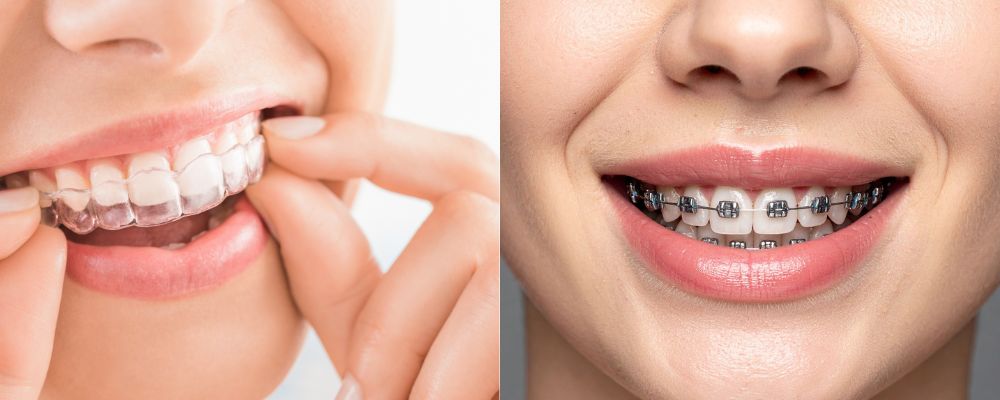
How metal braces and Invisalign work
Metal Braces: Tried, Tested, and Fixed
Metal braces use brackets, archwires, and sometimes elastics (rubber bands) to apply continuous pressure on teeth, gradually guiding them into the desired position. Because they are fixed, there’s no relying on the patient to insert them day by day—they simply work continuously.
Advantages of this method include strong control over tooth movement (especially root positioning), the ability to address complex cases, and reliability. Modern metal braces are also smaller and more comfortable than they used to be, with more aesthetic options (e.g. low-profile brackets).
However, fixed braces come with trade-offs: you’ll need adjustments (tightenings) periodically, there may be some irritation of the cheeks or lips initially, and they demand more careful hygiene around wires and brackets.
Invisalign: Clear, Removable Aligners
Invisalign is a series of clear, custom-made plastic aligners that you wear over your teeth. Every one to two weeks (depending on your plan), you switch to a new alignment tray that nudges your teeth gradually closer to the ideal position.
Key advantages are that Invisalign is very discreet (virtually invisible), allows you to remove the aligners to eat and clean your teeth, and tends to cause less soft-tissue irritation (no metal wires). But because they are removable, success depends heavily on patient compliance—you’ll typically need to wear the aligners 20–22 hours per day for them to do their job effectively.
“Are Metal Braces Better Than Invisalign?” — The Verdict (Context Matters)
When someone asks “Are metal braces better than Invisalign?”, the best possible answer is:
Metal braces are not universally better than Invisalign, but they can be better in specific situations—especially when the orthodontic requirements are complex, or when patient compliance with removable appliances might be uncertain.
Here are some scenarios where metal braces may outperform Invisalign:
Severe or complex tooth movements. When large rotations, significant vertical movements, or root control is needed, braces give the orthodontist more precise mechanical control.
Unreliable compliance. For younger patients or those who might forget or lose trays, braces ensure treatment is continuous and not interrupted by non-wear.
Greater cost sensitivity. In many cases, the cost of braces is lower than Invisalign for a similar result—though this depends on case complexity.
Better anchorage control. In some complicated cases (e.g. needing to pull molars back, closing spaces, coordinating jaw discrepancies), braces may offer better anchorage and force transmission.
That said, Invisalign might be better (or preferred) if:
- Your misalignment is mild to moderate.
- Aesthetic concerns are a high priority.
- You are disciplined and committed to wearing the trays faithfully.
- You want more flexibility in eating and hygiene.
- You accept investing more for the convenience and appearance benefits.
In many modern practices, the difference is narrower than it used to be. Advances in digital planning, attachments, and materials have allowed Invisalign to tackle more complex cases than before. Some dentists and orthodontists in Ireland now report outcomes for both systems can be very similar in suitable candidates.
Still, when pushing extremes (very severe misalignments or bite corrections), braces often remain the safer bet.
What We Do in Our Clinics (Dublin 4, 7, 12 & Cork City)
At our four clinics, we take a patient-first, evidence-based approach. Here’s how we apply the comparison above in practice:
Initial Assessment & 3D Scanning
At your first orthodontic consultation, we take digital scans, photos, and X-rays. We assess the severity of crowding, bite, jaw relationships, and any underlying skeletal issues. This lets us see whether Invisalign is suitable or whether braces would offer a more predictable path.
Personalised Recommendation
Based on your dental anatomy, goals, lifestyle, and budget, we may recommend either braces or Invisalign (or sometimes a hybrid approach). We’ll explain clearly why one might be more suited for you.
Compliance Discussion
If we propose Invisalign, we’ll talk through your daily routine, work schedule, and whether you believe you can reliably wear trays 20–22 hours a day. If not, braces may be safer for your outcome.
Cost Estimate & Payment Plans
We provide transparent cost estimates for both methods (for your specific case). In many instances, metal braces are less expensive—but we never push you into a choice solely based on price.
Support & Monitoring
Whichever treatment you choose, we schedule regular reviews. For braces, we tighten and monitor progress; for Invisalign, we check tray fit, compliance, and make midcourse corrections as needed.
Location Convenience
Because you may need periodic adjustment visits, we leverage our Dublin 4, Dublin 7, Dublin 12, and Cork City locations so you can attend the clinic most convenient to you.
By following this workflow, we help patients make informed, personalised choices rather than pushing a one-size-fits-all solution.
Common Questions (FAQs)
Q: Does Invisalign take longer than metal braces?
Not necessarily. For many mild to moderate cases, treatment time can be similar (often in the 12–18 month range). But if Invisalign trays are not worn enough, the treatment may drag on. Braces, being fixed, avoid that compliance risk.
Q: Will metal braces be more painful?
Both systems can cause discomfort—brackets and wires might rub, and adjustments can create soreness. Invisalign may feel less intrusive overall but can cause pressure when switching trays. Discomfort tends to ease after a few days.
Q: What about losing or forgetting Invisalign trays?
Yes, that is a drawback. Losing a tray or skipping wear time can slow your progress or require replacement costs. That risk doesn’t exist with fixed braces.
Q: Can I still have Invisalign if I already have crowns, veneers, or fillings?
In most cases, yes. But your clinician must evaluate tooth surfaces, attachments, and how aligners will grip. Sometimes certain restorative work influences which system is better.
Q: Does age matter?
Adults often prefer Invisalign for aesthetics, but age itself is not a limiting factor (so long as periodontal health is good). Younger patients may benefit more from fixed techniques due to compliance reliability.
Final Thoughts: Tailoring the Best Option for You
So, are metal braces better than Invisalign? The answer is: sometimes, but not always. The “better” option depends on the individual context—complexity of your tooth movements, how responsible you’ll be with aligners, your aesthetic goals, and your budget.
We believe the choice should always rest on a well-informed discussion, not marketing bias. In our clinics (Dublin 4, 7, 12 and Cork City), we’re proud to offer both treatment options and guide each patient toward the one most suited for their smile goals.
If you’d like a personalised consultation to see which is right for you, book your free orthodontic assessment at your nearest clinic. (Yes—we have clinics close to you in Dublin 4, 7, 12 and Cork City.)
Ready to take the first step toward a confident, straight smile? Contact us today.
Are Metal Braces Better Than Invisalign? What You Should Know
If you’re considering orthodontic treatment—whether for yourself or a family member—you’ve likely come across two popular options: metal braces (traditional fixed orthodontics) and Invisalign (clear aligners). A common question we hear at our dental clinics in Dublin 4, 7, 12 and Cork City is:
“Are metal braces better than Invisalign?”
The short answer is: it depends. Both systems have pros, cons, and ideal use cases. In this article, we’ll explore the differences in detail, help you decide which may be better for your situation, and explain how our clinics approach this question for patients in Ireland.
How Metal Braces and Invisalign Work
Metal Braces: Tried, Tested, and Fixed
Metal braces use brackets, archwires, and sometimes elastics (rubber bands) to apply continuous pressure on teeth, gradually guiding them into the desired position. Because they are fixed, there’s no relying on the patient to insert them day by day—they simply work continuously.
Advantages of this method include strong control over tooth movement (especially root positioning), the ability to address complex cases, and reliability. Modern metal braces are also smaller and more comfortable than they used to be, with more aesthetic options (e.g. low-profile brackets).
However, fixed braces come with trade-offs: you’ll need adjustments (tightenings) periodically, there may be some irritation of the cheeks or lips initially, and they demand more careful hygiene around wires and brackets.
Invisalign: Clear, Removable Aligners
Invisalign is a series of clear, custom-made plastic aligners that you wear over your teeth. Every one to two weeks (depending on your plan), you switch to a new alignment tray that nudges your teeth gradually closer to the ideal position.
Key advantages are that Invisalign is very discreet (virtually invisible), allows you to remove the aligners to eat and clean your teeth, and tends to cause less soft-tissue irritation (no metal wires). But because they are removable, success depends heavily on patient compliance—you’ll typically need to wear the aligners 20–22 hours per day for them to do their job effectively.
“Are Metal Braces Better Than Invisalign?” — The Verdict (Context Matters)
When someone asks “Are metal braces better than Invisalign?”, the best possible answer is:
Metal braces are not universally better than Invisalign, but they can be better in specific situations—especially when the orthodontic requirements are complex, or when patient compliance with removable appliances might be uncertain.
Here are some scenarios where metal braces may outperform Invisalign:
Severe or complex tooth movements. When large rotations, significant vertical movements, or root control is needed, braces give the orthodontist more precise mechanical control.
Unreliable compliance. For younger patients or those who might forget or lose trays, braces ensure treatment is continuous and not interrupted by non-wear.
Greater cost sensitivity. In many cases, the cost of braces is lower than Invisalign for a similar result—though this depends on case complexity.
Better anchorage control. In some complicated cases (e.g. needing to pull molars back, closing spaces, coordinating jaw discrepancies), braces may offer better anchorage and force transmission.
That said, Invisalign might be better (or preferred) if:
- Your misalignment is mild to moderate.
- Aesthetic concerns are a high priority.
- You are disciplined and committed to wearing the trays faithfully.
- You want more flexibility in eating and hygiene.
- You accept investing more for the convenience and appearance benefits.
In many modern practices, the difference is narrower than it used to be. Advances in digital planning, attachments, and materials have allowed Invisalign to tackle more complex cases than before. Some dentists and orthodontists in Ireland now report outcomes for both systems can be very similar in suitable candidates.
Still, when pushing extremes (very severe misalignments or bite corrections), braces often remain the safer bet.
What We Do in Our Clinics (Dublin 4, 7, 12 & Cork City)
At our four clinics, we take a patient-first, evidence-based approach. Here’s how we apply the comparison above in practice:
Initial Assessment & 3D Scanning
At your first orthodontic consultation, we take digital scans, photos, and X-rays. We assess the severity of crowding, bite, jaw relationships, and any underlying skeletal issues. This lets us see whether Invisalign is suitable or whether braces would offer a more predictable path.
Personalised Recommendation
Based on your dental anatomy, goals, lifestyle, and budget, we may recommend either braces or Invisalign (or sometimes a hybrid approach). We’ll explain clearly why one might be more suited for you.
Compliance Discussion
If we propose Invisalign, we’ll talk through your daily routine, work schedule, and whether you believe you can reliably wear trays 20–22 hours a day. If not, braces may be safer for your outcome.
Cost Estimate & Payment Plans
We provide transparent cost estimates for both methods (for your specific case). In many instances, metal braces are less expensive—but we never push you into a choice solely based on price.
Support & Monitoring
Whichever treatment you choose, we schedule regular reviews. For braces, we tighten and monitor progress; for Invisalign, we check tray fit, compliance, and make midcourse corrections as needed.
Location Convenience
Because you may need periodic adjustment visits, we leverage our Dublin 4, Dublin 7, Dublin 12, and Cork City locations so you can attend the clinic most convenient to you.
By following this workflow, we help patients make informed, personalised choices rather than pushing a one-size-fits-all solution.
Common Questions (FAQs)
Common Questions (FAQs)
Q: Does Invisalign take longer than metal braces?
Not necessarily. For many mild to moderate cases, treatment time can be similar (often in the 12–18 month range). But if Invisalign trays are not worn enough, the treatment may drag on. Braces, being fixed, avoid that compliance risk.
Q: Will metal braces be more painful?
Both systems can cause discomfort—brackets and wires might rub, and adjustments can create soreness. Invisalign may feel less intrusive overall but can cause pressure when switching trays. Discomfort tends to ease after a few days.
Q: What about losing or forgetting Invisalign trays?
Yes, that is a drawback. Losing a tray or skipping wear time can slow your progress or require replacement costs. That risk doesn’t exist with fixed braces.
Q: Can I still have Invisalign if I already have crowns, veneers, or fillings?
In most cases, yes. But your clinician must evaluate tooth surfaces, attachments, and how aligners will grip. Sometimes certain restorative work influences which system is better.
Q: Does age matter?
Adults often prefer Invisalign for aesthetics, but age itself is not a limiting factor (so long as periodontal health is good). Younger patients may benefit more from fixed techniques due to compliance reliability.
Final Thoughts: Tailoring the Best Option for You
So, are metal braces better than Invisalign? The answer is: sometimes, but not always. The “better” option depends on the individual context—complexity of your tooth movements, how responsible you’ll be with aligners, your aesthetic goals, and your budget.
We believe the choice should always rest on a well-informed discussion, not marketing bias. In our clinics (Dublin 4, 7, 12 and Cork City), we’re proud to offer both treatment options and guide each patient toward the one most suited for their smile goals.
If you’d like a personalised consultation to see which is right for you, book your free orthodontic assessment at your nearest clinic. (Yes—we have clinics close to you in Dublin 4, 7, 12 and Cork City.)
Ready to take the first step toward a confident, straight smile? Contact us today.